Expanded Options under a Multi-Evidence Paradigm
The paper that exposed the limits of counterfactual causal inference and capacities of a multi-evidence paradigm.
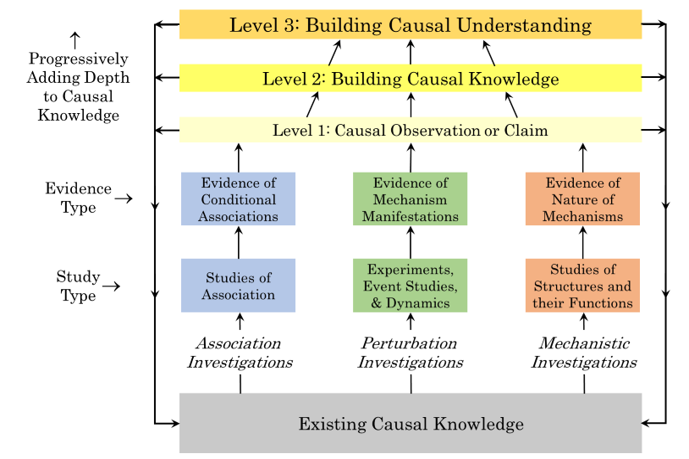
Figure 3.1. The Multi-Evidence Paradigm recognizes a number of different ways to advance causal knowledge. These include the estimation of counterfactual causal effects (the only estimand sanctioned under the Counterfactual Causal Inference Paradigm). This will be shown below as Illustration 1.1.
Investigation 1: Response of Mangrove Trees to Extreme Freeze
Dr. Melinda Martinez, Principle scientist for the mangrove freeze causal investigation. Stanford University, Physical Science Research Scientist
Martinez, Melinda, et al. "Integrating remote sensing with ground-based observations to quantify the effects of an extreme freeze event on black mangroves (Avicennia germinans) at the landscape scale." Ecosystems 27.1 (2024): 45-60.

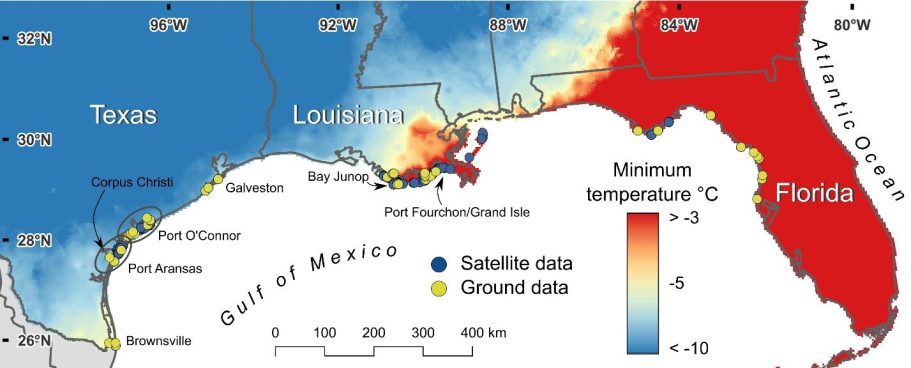
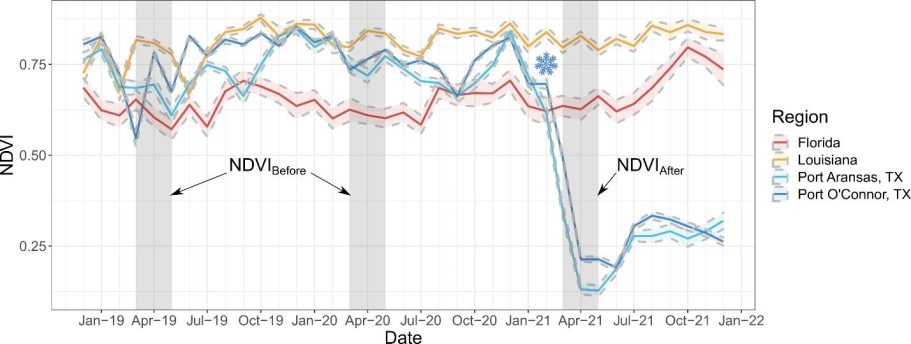
Figure 3.2. Data used for estimating the causal effects of an extreme freeze event on black mangrove trees. The vertical grey zones represent comparable before–after time periods in the seasonal oscillations of NDVI used for counterfactual comparisons.
Illustration 1.1: Counterfactual Causal Effects
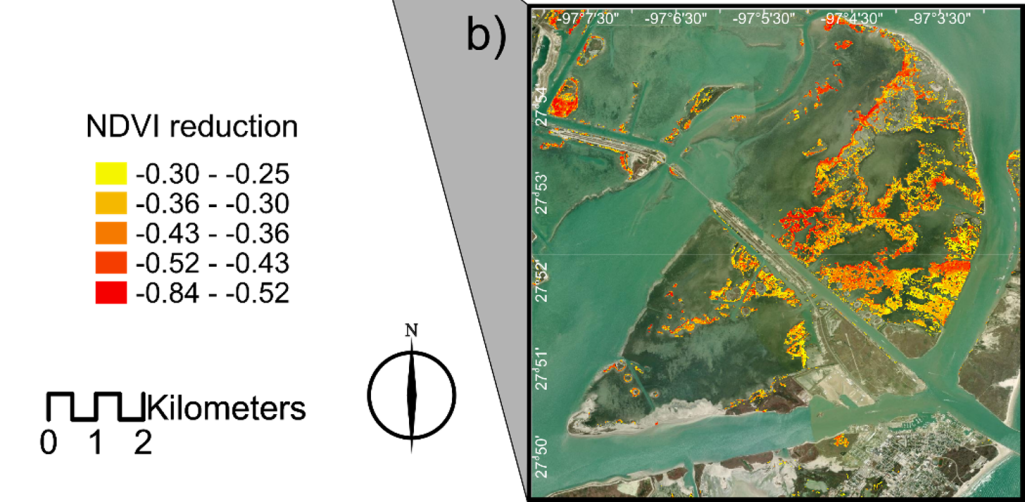
Figure 3.3. | The Information Content of Causal Effect Estimates
It is useful to consider the information content of average causal effect estimates.
Counterfactually-defined causal effect estimates (NDVI reductions in this case) represent point estimates specific to the sample of data analysed. As shown above, causal effect estimates were found to vary widely in space in this study. As is typical of counterfactual causal effects, they have no inherent way to produce transportable causal knowledge. Within the Multi-Evidence paradigm, they are thought of as "causal observations."
Major Takehome Point: Counterfactual Causal Inference yields no Transportable Causal Knowledge, only estimates of "What happened?" (causal effects).
Illustration 1.2: Characterizing Mechanistic Causal Elements
Mangrove Freeze Tolerance
Figure 3.4. Our study ignored the requirements for counterfactual causal effects, which would be challenged by pooling data across sites that are very clearly not counterfactually comparible. Instead, we combined data and use standard logistic regression to estimate mangrove freeze tolerance.
This example violates the claim by causal statistics that standard statistical estimation methods are only "predictive" and therefore, non-causal (Arif, S., & MacNeil, M. A. 2022. Predictive models aren't for causal inference. Ecology Letters, 25(8), 1741-1745.
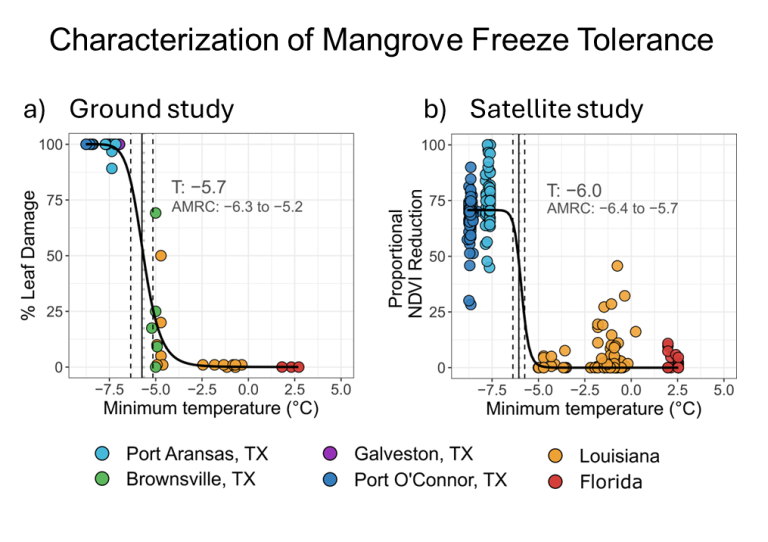
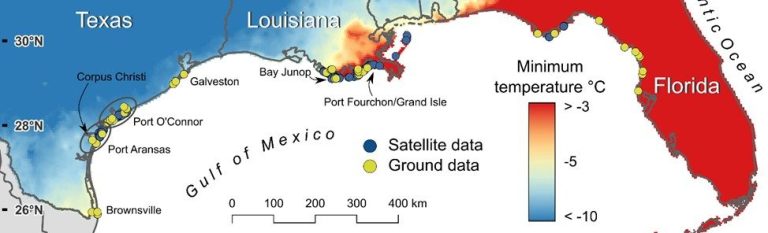
Illustration 1.3: Documented Transportability - Independent Confirmation
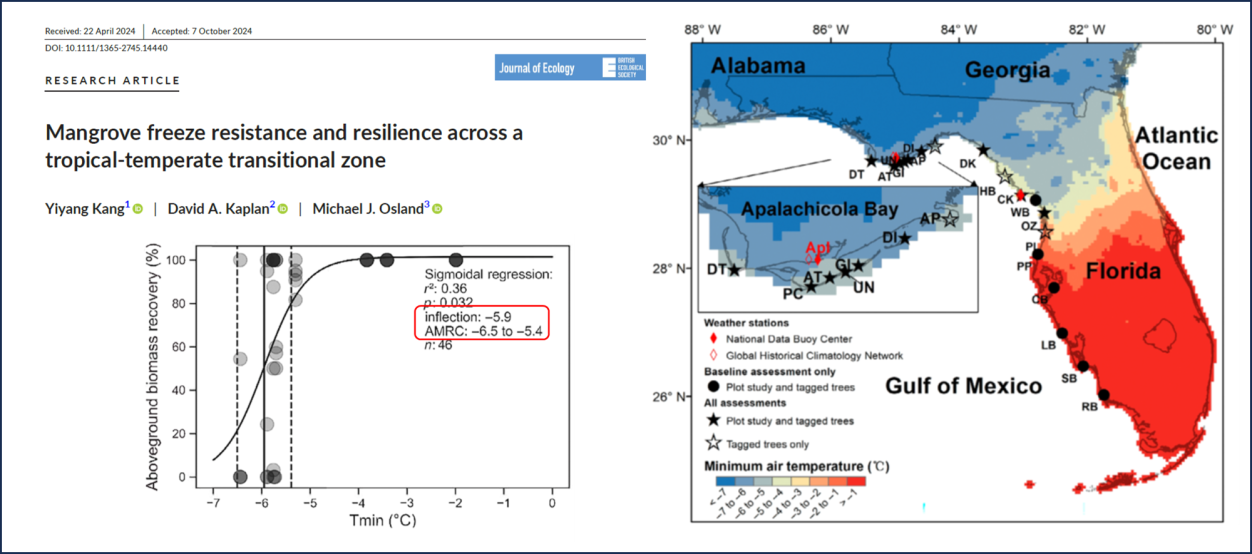
Figure 3.5. Independent estimates confirm that freeze tolerance is, as expected, a stable plant trait widely transportable (i.e., it is a "thing" to be characterized, not an "effect".