Causal Knowledge Analysis: Converting mechanistic information into causal knowledge
The most basic goal of Causal Knowledge Analysis is to convince causal statisticians or their adherents that you have substantial knowledge of the mechanistic elements (structures and processes) relevant to some question of interest. This, of course, will not always be the case but the assumption currently being made is that it is such a remote possibility that it can be ignored. Thus, counterfactual causal inference = causal inference as far as the "Counterfactual Causal Inference Paradigm" is concerned. In the section entitled "Understanding the Literature" I will provide a deeper explanation of the assumptions made by causal statisticians that mechanistic scientists will perhaps find to be shocking.
What one needs to understand at this point is that empirical examples are perhaps the only route to convincing causal statisticians that their approach is not the only valid one, but also that it is neither a complete nor sufficient paradigm (not to mention that it is massively misleading). This is where explicit documentation of the evidence that leads a scientist to draw interpretations using terms like “effects,” “responses,” “drivers,” and “influences” is now becoming a requirement without scientists' being aware.
To illustrate what we are up against, a just-published paper in a prominent journal promoting counterfactual causal requirements stated,
“While consistent findings from predictive models may contribute to pre-existing or “mechanistic” ecological knowledge (Grace 2024, 5), particularly when supported by ecological theory and expert understanding, predictive performance alone is insufficient to justify causal claims.”
I think this remark reveals three things:
(1) the authors refer to and think of counterfactual methods as the only valid causal method,
(2) they refer to everything that isn't a counterfactual method as "predictive inference" and therefore not causal, which forms the bookend for their semantic hijack of causal authority,
(3) they do not know how to even think about "mechanistic" knowledge, to the degree to which they place this standard scientific term in quotes.
A second, but ultimately more important goal for causal knowledge analysis is to build causal knowledge.
Simply put, if we don't document the evidence of causal knowledge, how can we build upon it?
Returning to Illustration 1.2: Characterizing Mangrove Freeze Tolerance using Mechanistic Knowledge
Figure 4.1. Here I include a Causal Knowledge Diagram for the mechanistic basis for claiming plant freeze tolerance is a causal element.
The reason we can estimate freeze tolerance directly as a non-linear threshold is because it is "thing", or attribute/trait something that exists in the world, not a correlation from a data set. This is an illustration of "mechanistic causal characterization". It does not produce a counterfactual causal effect, which would be an oversimplified representation of how plants respond to freeze events.
Next I will provide a more detailed illustrations of CKA.
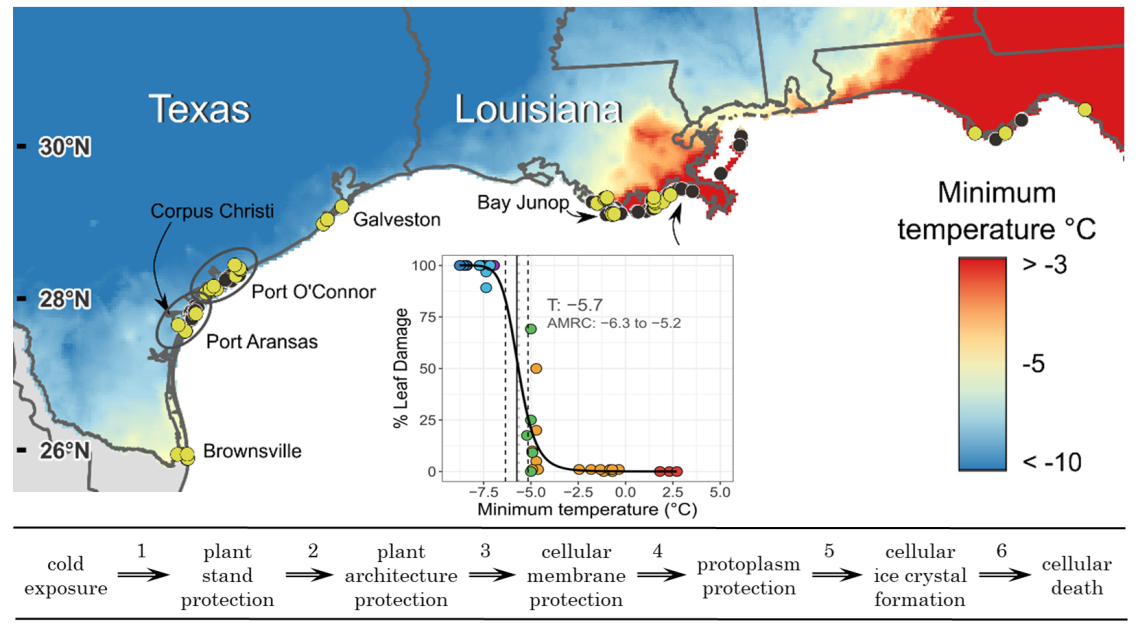
Illustration 2: Mechanistic Causal Determination
Figure 4.2. Illustration of causal knowledge analysis and mechanistic causal determination.
(A) Reported relationship between the phosphorus content of feces as a function of animal body size for herbivores in African savannas (28).
(B) Illustration of African herbivores of differing body sizes.
(C) Causal knowledge diagram documenting a chain of biophysical and physiological processes whereby body size influences the phosphorus content of their excrement.
(D) Picture of Galileo Galelei who theorized in the year 1638 that larger animals would have to devote a greater fraction of their body mass to skeletal material due to principles of biophysics.
(E) The relationship between skeletal mass and body size for herbivores studied by LeRoux et al. (28) projected from established allometry relations (29).
(F) Phosphorus retention fraction as a function of estimated skeletal mass fraction.
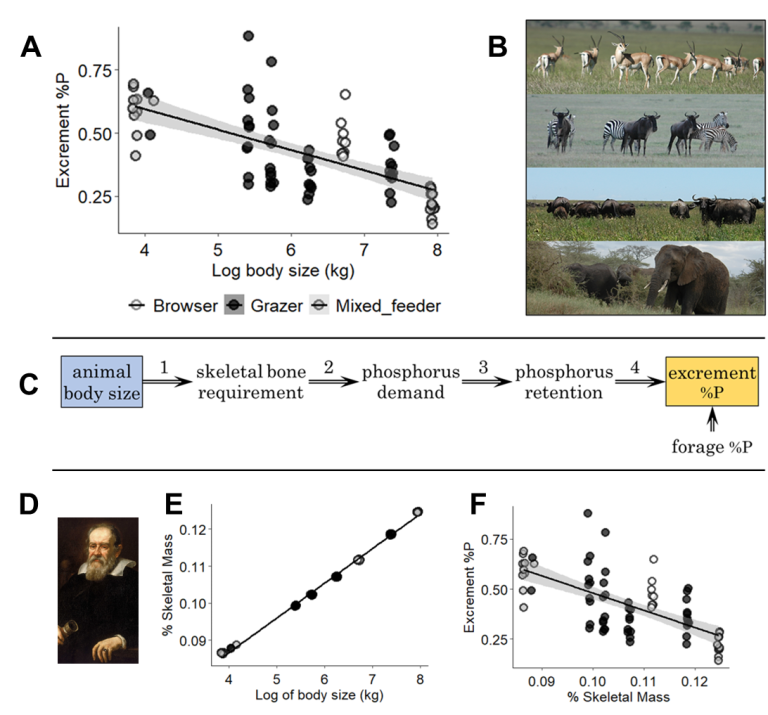
Illustration 3: Integrated Causal Characterization - Wildfire Example
Figure 4.3. Dynamics of forest cover were obtained for a major wildfire in 2003 in Glacier National Park from Landsat satellites.
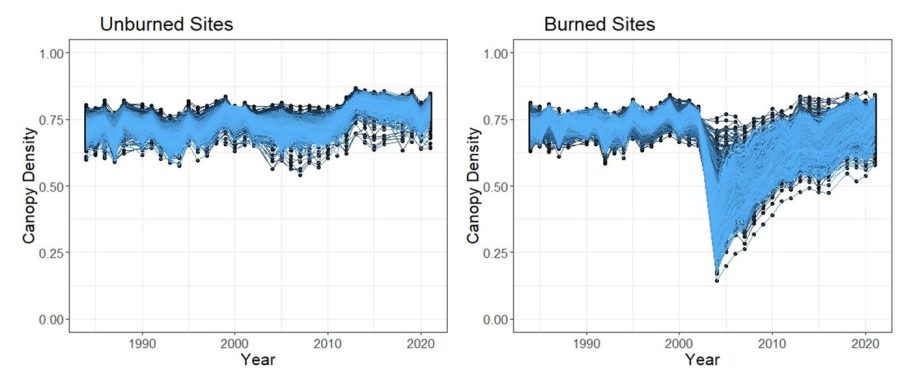
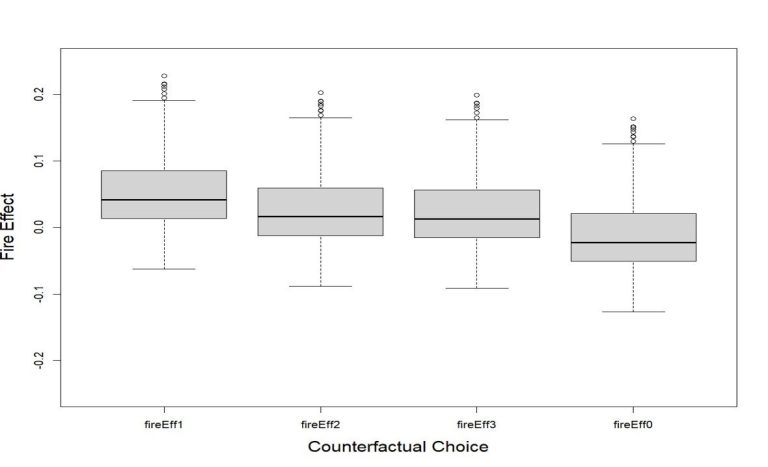
Figure 4.4. Counterfactual causal inference techniques were used to calculate causal effects using a variety of counterfactual assumptions. All choices were in agreement that forest cover recovered completely 22 years following fire.
Figure 4.5. A depiction of the structural elements and how they are known to change over time was developed and overlaid with a Causal Knowledge Diagram. Double line arrows are used to denote that this is a representation of causal knowledge, not statistical connections (this is not DAG, path diagram, or any other representation of data associations). Documentation for the numbered mechanistic links are reported in the full paper. These links are ultimately supportable at the level of physics, biology, and soil chemistry.
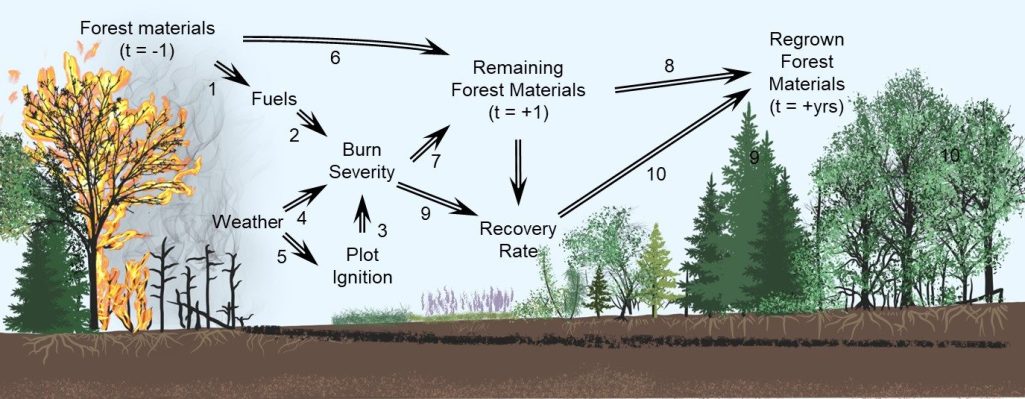
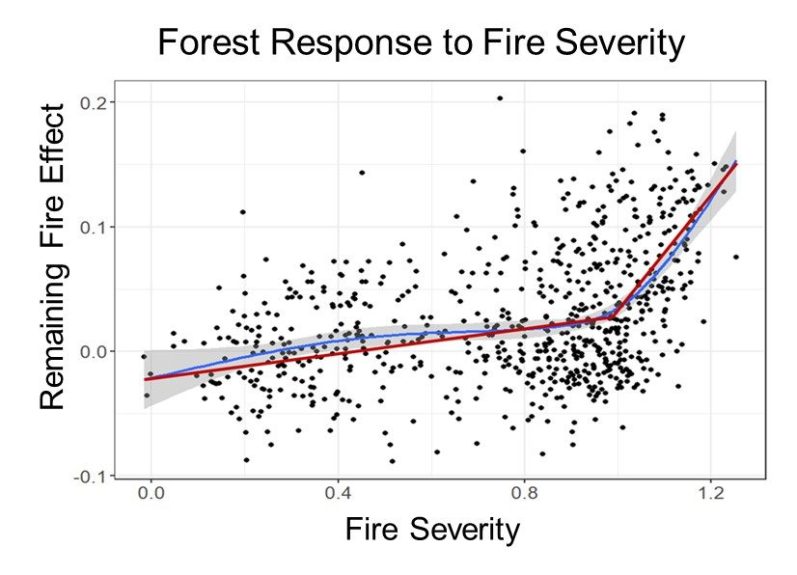
Figure 4.6. With support from existing mechanistic causal knowledge, it was possible to estimate the shape of response to the severity of fire at each sample point, revealing a threshold. Further analyses showed that the response form was stable, independent of counterfactual choice, and transportable to other situations.

Causal Knowledge Specialist - Dr. Billy Schweiger, NPS Rocky Mountain Inventory and Monitoring.